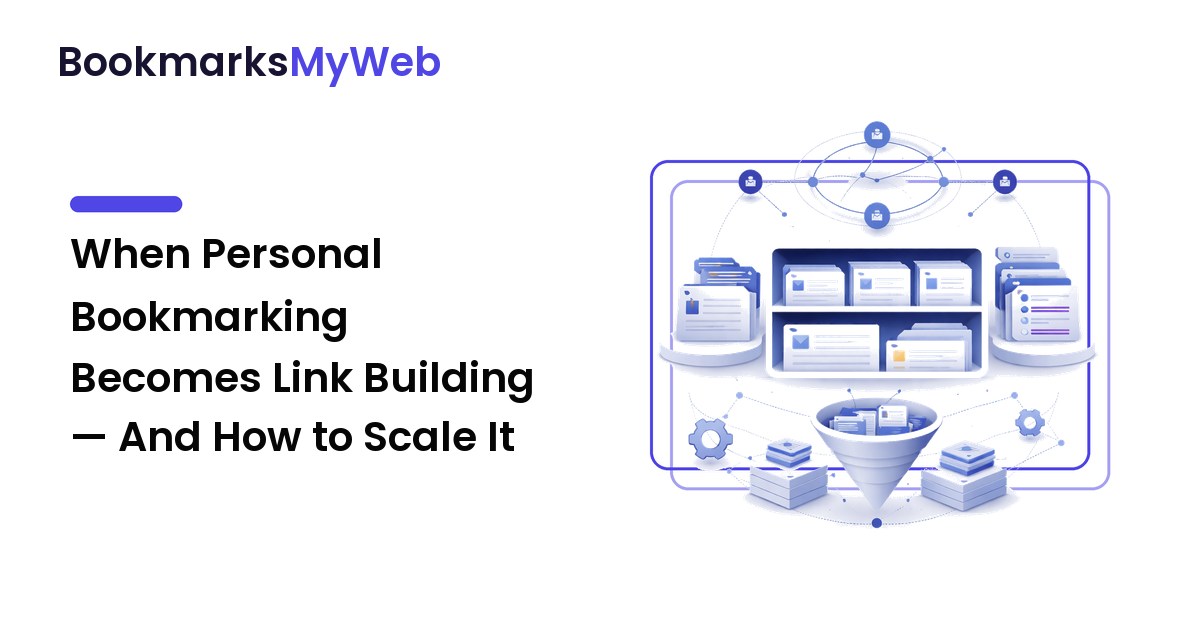
For most people, bookmarking is a calm, private habit: you find a page worth keeping, you save it, and later you find it again. Nothing about that is link building. But the moment you start saving your own pages to public bookmarking sites — or saving pages with the deliberate goal of helping something get found — you've quietly crossed into link building. The two activities use the same button and feel identical, but they have completely different goals, and confusing them is how a peaceful library habit turns into a draining chore.
The takeaway up front: keep your personal library and your public link work as two separate systems with two different purposes. Your library is for retrieval. Your public link work is for visibility, and once it's deliberate, it follows link-building rules — which means it should be planned, measured, and, where it becomes repetitive, outsourced rather than ground out by hand.
The line between saving and link building
The difference isn't the tool; it's the intent and the audience.
Personal saving is for future you. The only person who needs to find the bookmark again is you. It can be private, messy, tagged however your brain works. Search guidelines, anchor text, and indexing are irrelevant — this is just memory.
Link building is for other people and crawlers. You're placing a public, relevant link to a page because you want it discovered. Now the things that don't matter for personal saving suddenly matter a lot: is the platform real and active, is the page indexed, does the link read as natural rather than spammy?
If you've worked through the social bookmarking guide, you've seen this distinction in passing. The point worth internalizing is that the same click means two different things, and you should never let your retrieval system and your visibility system blur into one undifferentiated pile of "stuff I saved."
Keep the library calm; treat link work as work
The mistake that burns people out is running link building through their personal library — saving their own pages everywhere, re-sharing, chasing indexing, all mixed into the tool they relied on for quiet retrieval. Suddenly the calm habit feels like a marketing job, and both suffer.
A cleaner setup:
- Library: optimized purely for retrieval — fast saving, good tags, strong search. Private or public, it doesn't matter, because the audience is you.
- Link work: a separate, deliberate process with its own target list of quality public platforms, its own descriptions, and its own measurement. This is where SEO rules apply.
Drawing that boundary keeps your library trustworthy and lets you treat link building honestly as the repetitive production task it is.
Where the SEO side turns into busywork
Once link building is deliberate, the work is mostly mechanical and that's the problem. The judgement part is small and one-time: decide which pages deserve visibility, which platforms are worth using, and how the links should read. The labor part is large and endless:
- Submitting the same page across many quality public platforms.
- Writing a fresh, non-duplicate description for each.
- Spacing submissions so nothing spikes unnaturally.
- Getting links crawled and checking what stuck.
This is the part that quietly eats hours and makes people resent the whole exercise. It's also exactly the kind of repetitive labor that's a candidate for outsourcing — not because it's unimportant, but because it doesn't need your judgement once the plan exists.
Scaling the SEO side without the grind
When the link-building labor outgrows your patience, the fragmentation trap waits: separate freelancers for bookmarking, indexing, and listings, each with their own quality and turnaround. The tidier route is a wholesale marketplace where these production services sit behind one account.
SEOeStore is a long-established example — social bookmarking, indexing, and related off-page services are catalog items you order on demand. The reason it fits the scaling problem here: breadth in one account means the repetitive submission and indexing work comes back on one balance and one dashboard, instead of you personally filling forms or coordinating several vendors. It removes the labor of the SEO side, not the judgement. You still choose which pages matter, approve how the links read, and read the results. Your calm library stays untouched and entirely yours.
Hold to the discipline that keeps this safe:
- Brief from your own plan. Hand over your target pages, vetted platforms, and description angle — not a blank "build links" instruction.
- Test ten before a hundred. Order a small batch, then verify the platforms are real and the links landed and indexed.
- Distrust volume promises. "Hundreds of backlinks, all dofollow, guaranteed" is the marketing of manipulation, not link building.
- Pace and measure. Drip the work, track indexation and any referral interest, and keep only what produces signal.
What stays a human job
Outsourcing the mechanical submissions frees you to do the parts that actually move the needle and can't be bought: making pages genuinely worth linking to, and earning the occasional real, editorial link through relationships. A marketplace can scale the breadth of low-touch submissions; it can't manufacture genuine interest. The healthy balance is outsourced production handling volume, with your own time spent on quality and the few links worth a human touch — and your personal library left in peace.
FAQ
When does my bookmarking actually count as link building?
The moment your intent shifts from "I want to find this later" to "I want this page discovered by others or crawlers," and you're saving to public platforms to make that happen. Same click, different goal. Private saving for retrieval is never link building.
Can I just use my personal bookmarking library for SEO too?
You can, but it usually backfires — your retrieval system gets cluttered with promotional saves and the link work feels like a chore. Keeping them separate keeps your library trustworthy and lets you run link building as a clean, measurable process.
Is buying bookmarking and indexing services against search guidelines?
Buying links purely to manipulate rankings is against guidelines. Paying for the labor of submitting legitimate, relevant links to real platforms and getting them indexed is an ordinary operational choice. The risk is in the quality and intent of what's placed, not in paying someone to file it.
How do I scale link building without it becoming spam?
Keep the judgement — page selection, platform vetting, how links read — and only outsource the typing. Test small, pace delivery, refuse volume-for-volume's-sake offers, and measure indexation and traffic. Spam is volume without relevance; controlled production with your shortlist behind it is not.
Next step
Draw the boundary first: keep one system for your private library and a separate, deliberate process for public link work. List the pages that genuinely deserve visibility and the platforms worth using. Then, for the repetitive submission and indexing labor, brief one service and place a small test order through a wholesale marketplace like SEOeStore — measure indexation before you scale. That's how you grow the SEO side without sacrificing the calm bookmarking habit that started it.